


How SaaS Platforms Can Reduce WISMO Tickets by 75% with Proactive Tracking
What Is WISMO and Why It's Killing Your Support Team
WISMO — "Where Is My Order?" — is the single most common customer service request in e-commerce. Industry data shows that up to 90% of support tickets in post-purchase experience are WISMO-related.
For SaaS platforms serving e-commerce merchants, this creates a compounding problem:
- Your merchant clients get flooded with "where's my package?" emails
- They blame your platform for poor visibility
- Your support team inherits the escalations
- Churn risk increases every time a shipment goes dark
The cost is real. A mid-sized e-commerce SaaS handling 500,000 shipments per month, with a $3 average cost per support ticket, spends $1.5M+ annually just answering questions that technology should answer automatically.
Why Traditional Tracking Falls Short
Most platforms handle tracking reactively: a customer submits a support ticket, an agent manually looks up the tracking number, copies the result, and responds. This is slow, expensive, and completely avoidable.
Even platforms that offer a tracking page still miss the core problem. A tracking page only helps customers who know to look. Most don't. They default to emailing support.
The root cause: no proactive notification when shipment status changes.
The Fix: Proactive Tracking via Webhook API
Proactive tracking flips the model. Instead of waiting for customers to ask, your platform pushes status updates automatically the moment something changes.
Here's how it works with a tracking API:
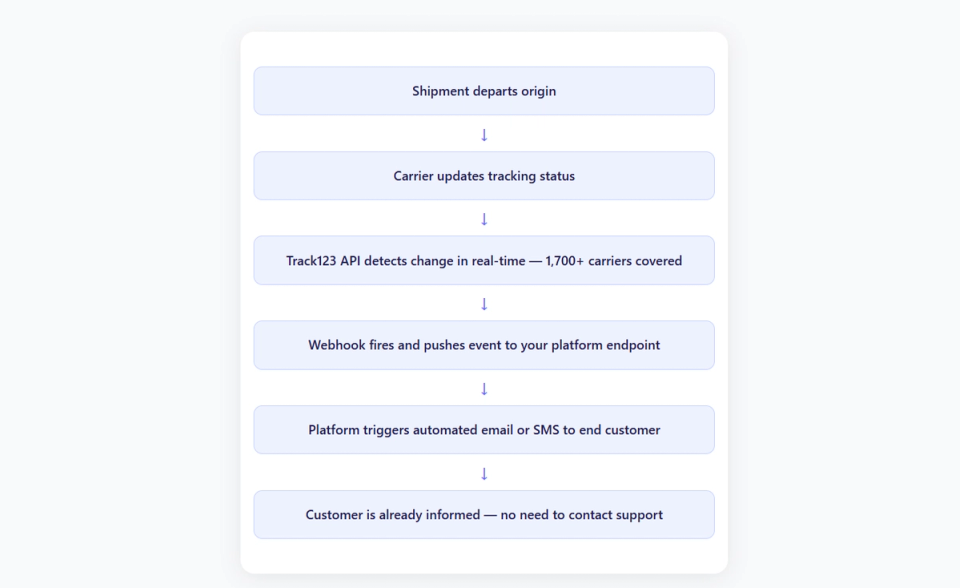
The result: WISMO tickets drop by up to 75% because customers receive updates before they think to complain.
What to Look for in a Tracking API
Not all tracking APIs are built the same. For SaaS platforms, these are the capabilities that actually matter:
1. Carrier Coverage
A tracking API is only as good as its carrier network. If your merchants ship with regional carriers, last-mile providers, or China-origin logistics (EMS, Cainiao, SF Express), you need coverage that goes beyond FedEx, UPS, and USPS.
Look for APIs covering 1,000+ carriers at minimum. Track123 covers 1,700+ carriers globally, including major China-origin and cross-border carriers.
2. Webhook Support
Real-time webhook notifications are non-negotiable for proactive tracking. Avoid APIs that only support polling — polling introduces latency and burns API quota.
Track123 supports webhook push notifications the moment a tracking status changes, with configurable event filters so you only receive the events you care about.
3. Data Reliability
Inconsistent carrier data is the silent killer of tracking products. Carriers report status in different formats, languages, and update frequencies. A good tracking API normalizes all of this into a consistent data schema.
Track123 maintains a 99.9% tracking success rate across its carrier network, with standardized status codes that map cleanly to your platform's data model.
4. Scalability
SaaS platforms don't have fixed shipment volumes. You need an API that scales with your merchants' peak seasons (Q4, 11.11, Black Friday) without degraded performance.
Implementation Overview
Integrating proactive tracking into an existing SaaS platform typically takes less than a day of engineering time:
Step 1: Create tracking subscriptions
Step 2: Receive webhook events
Step 3: Trigger your notification logic Map the incoming status to your notification templates and fire the customer-facing message via your existing email/SMS provider.
No need to rebuild your notification infrastructure — the tracking API handles carrier data normalization, your platform handles the customer communication layer.
Getting Started with Track123 API
Track123 provides a shipment tracking API built for SaaS platforms and enterprise integrations:
- 1,700+ carriers covered globally
- 99.9% tracking success rate
- Real-time webhook notifications
- Clean REST API with comprehensive documentation
- Free tier available for development and testing