


Track123 vs 17track API: Which Shipment Tracking Solution Is Built for Scale?
If you're evaluating shipment tracking APIs, the surface-level features look similar: both Track123 and 17track support carrier auto-detection, webhook notifications, and batch tracking registration. But the implementation details — throughput limits, quota mechanics, update frequency, data retention — tell a very different story when you're running at scale.
This comparison covers everything a developer or technical decision-maker needs to evaluate both platforms side by side.
Pricing Model: Monthly Flexibility vs. Annual Commitment
Before writing a single line of integration code, the billing model shapes your architecture decisions.
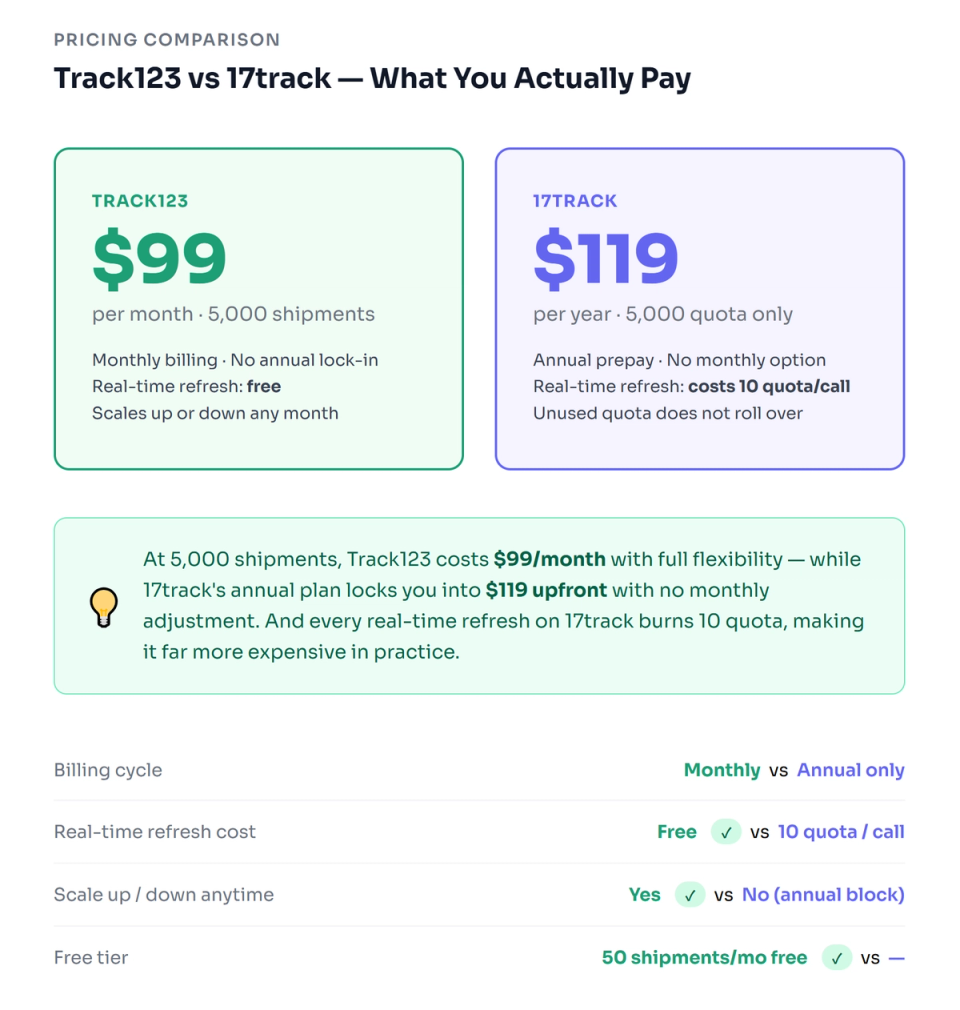
17track sells quota in annual packages — you pay upfront for a fixed number of API calls valid for 12 months. There is no monthly option. Unused quota does not roll over, and if you run out mid-year, you purchase another block.
- 5,000 quota — $119/year
- 25,000 quota — $569/year
- 150,000 quota — $2,869/year
- 500,000 quota — $9,299/year
- 1,000,000 quota — $18,499/year
- 2,000,000 quota — $34,999/year
Track123 charges monthly by shipment volume — 1 shipment consumes 1 quota credit. No annual lock-in, no upfront bulk purchase. You pay for what you actually track each month and can scale up or down freely.
- Up to 50 shipments — Free
- 300 shipments — $9/month
- 700 shipments — $19/month
- 1,000 shipments — $29/month
- 2,000 shipments — $49/month
- 5,000 shipments — $99/month
- 10,000 shipments — $179/month
- 20,000 shipments — $299/month
- 50,000 shipments — $599/month
For teams with seasonal spikes, rapid growth, or variable monthly volume, being locked into an annual quota estimate is a real operational risk. Track123's monthly model removes that uncertainty entirely.
Beyond the billing cycle, there's a structural cost difference worth highlighting: with 17track, every real-time status refresh costs 10 quota credits. On a 25,000-quota plan, refreshing just 2,500 shipments once in real time consumes your entire annual allowance. Track123 supports real-time refresh at no additional quota cost.
API Throughput: Headroom for High-Volume Integrations
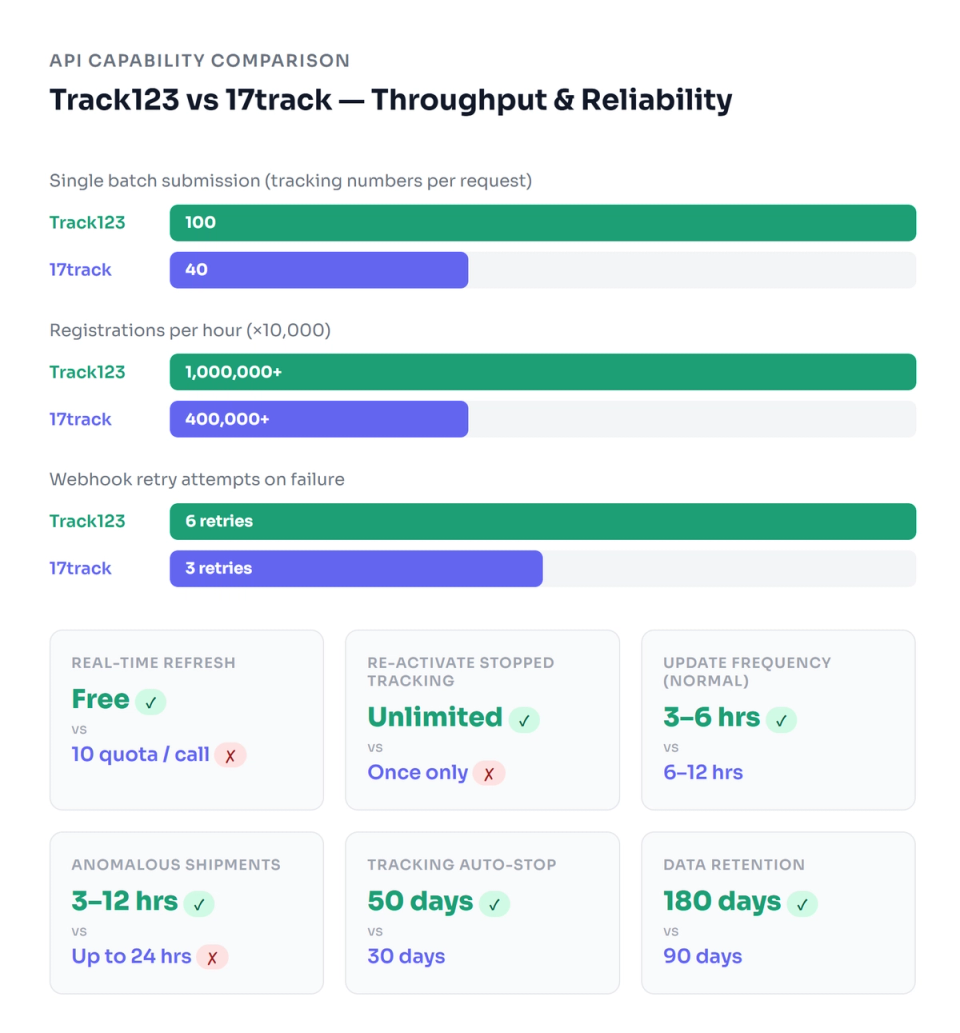
Track123 and 17track diverge significantly on the raw throughput metrics that matter most for production integrations.
Batch submission limit: Track123 accepts 100 tracking numbers per request; 17track caps at 40. For bulk registration workflows, this means 2.5x fewer API calls to register the same volume of shipments.
Registrations per hour: Track123 supports over 1,000,000 registrations per hour. 17track's ceiling is around 400,000. If you're onboarding historical order data or running high-frequency imports, this gap matters.
Real-time refresh: Track123 supports it at no quota cost. 17track charges 10 quota credits per refresh call — making real-time refresh prohibitively expensive at scale.
Webhook retry logic: Track123 retries failed webhook deliveries up to 6 times. 17track retries up to 3 times. In environments with transient downstream failures, twice the retry attempts means significantly fewer missed status updates.
Re-activating stopped tracking: Track123 allows unlimited re-activations on a stopped shipment. 17track permits only one re-activation. For long-tail shipments or customer service workflows that need to restart tracking on demand, this is a hard constraint with 17track.
Tracking Performance: Update Frequency and Data Retention
Fresher data means better customer experiences and fewer support tickets. The gap here is consistent and measurable.
Ongoing update frequency: Track123 polls carrier data every 3–6 hours under normal conditions, with anomalous shipments updated every 3–12 hours. 17track updates every 6–12 hours, with anomalous shipments waiting up to 24 hours. For time-sensitive delivery status, Track123 consistently delivers more recent data.
Auto-stop condition: Track123 continues tracking a shipment until it goes 50 consecutive days without an update. 17track stops at 30 days. For slow international routes or customs-delayed shipments, this 20-day buffer can be the difference between a tracked delivery and a shipment that silently disappears from your system.
Data retention: Track123 retains shipment records for 180 days. 17track deletes data after 90 days. If you're building analytics pipelines, dispute resolution tooling, or any feature that references historical shipment data, the 17track retention window is half what you get with Track123.
Data Management and Developer Experience
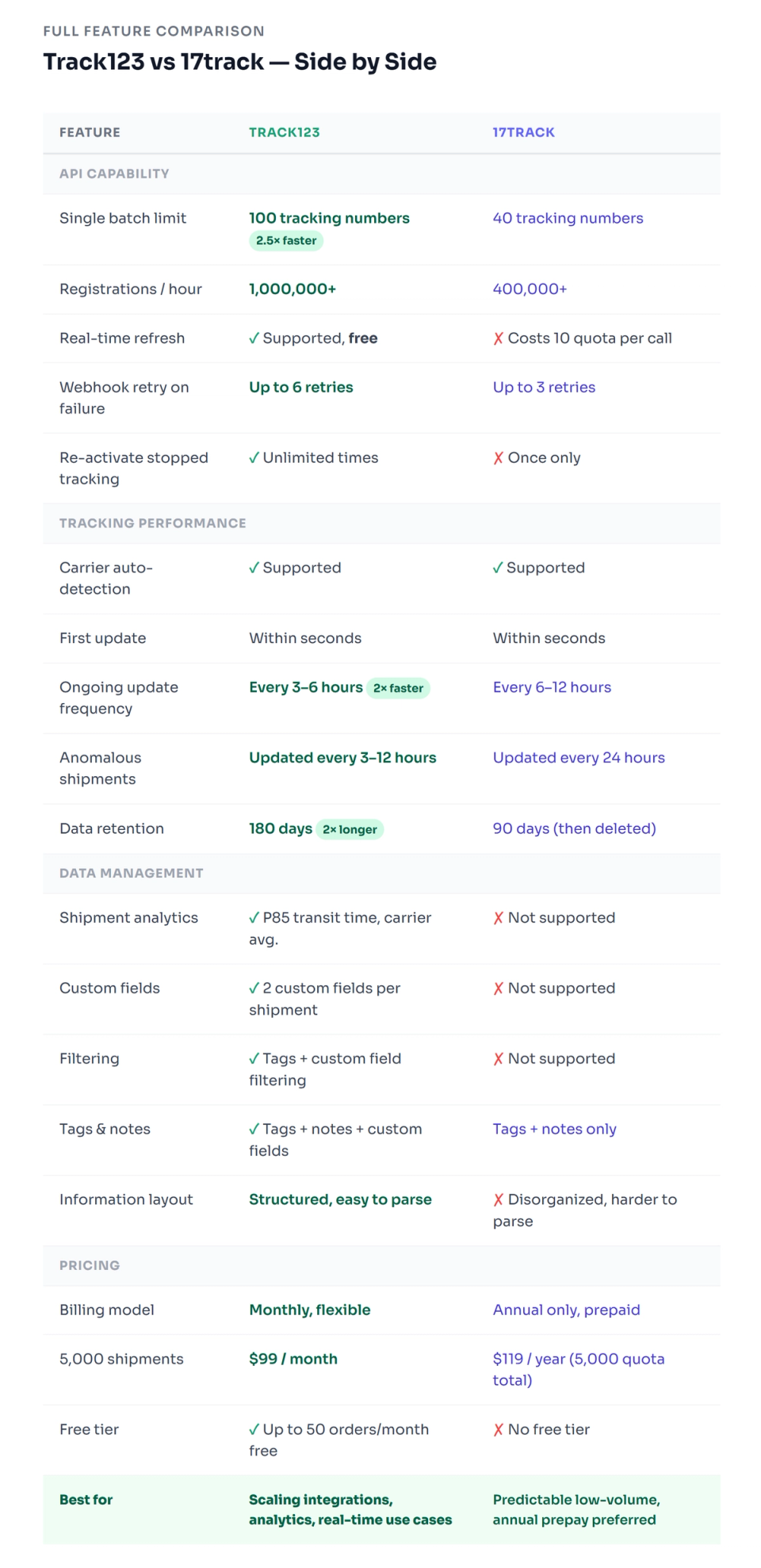
Beyond raw API performance, the quality of the data surface and management tooling determines how much custom infrastructure you need to build around the integration.
Shipment analytics: Track123 exposes P85 transit time metrics and per-carrier average transit durations via its analytics module. This data is immediately useful for SLA monitoring, carrier performance dashboards, and customer expectation tooling — without any additional aggregation layer. 17track provides no equivalent analytics.
Custom fields: Track123 supports two custom fields per tracking record, alongside tags and notes. This gives developers a clean way to attach internal metadata — order IDs, warehouse codes, customer segments — directly to tracking objects. 17track supports tags and notes but does not support custom fields.
Filtering: Track123 supports filtering by tags and custom fields. 17track does not support shipment filtering via the API.
Information layout: Track123's API responses are cleanly structured, with status, online time, transit duration, and delivery information in consistent, parseable fields. 17track's response structure is less organized, which typically means more normalization work on the client side.
Who Should Use Each Platform?
Choose Track123 if:
- You need monthly billing flexibility — seasonal spikes, growth-stage volume, or variable load
- Your integration uses real-time refresh — quota-free refresh is a meaningful cost advantage
- You're building analytics features and want P85/carrier performance data out of the box
- You need 180-day data retention for historical queries, disputes, or compliance
- You want robust webhook delivery with 6 retries and unlimited tracking re-activations
17track may be sufficient if:
- Your volume is highly predictable year-over-year and annual upfront payment is not a constraint
- You never need to refresh tracking status in real time
- 90-day retention and 30-day auto-stop cover your use case
For production integrations designed to scale, Track123 is the stronger technical choice. The monthly billing model eliminates quota over-commitment risk, real-time refresh costs nothing extra, tracking is more frequent and longer-lived, and the analytics surface removes a layer of custom infrastructure. 17track suits predictable, low-volume use cases — but its constraints compound quickly as your integration grows.