


Track123 vs AfterShip (2026): Same Features, 83% Less Cost
If you're shopping for a shipment tracking solution, AfterShip is almost certainly on your list. It's the most recognized name in the space — established, feature-rich, and widely integrated. So why are more and more eCommerce sellers switching to Track123?
The short answer: Track123 delivers everything a growing brand needs from a tracking platform, at a fraction of the price. This article breaks down the differences across pricing, carrier coverage, tracking page customization, analytics, and API — so you can make a fully informed decision.
At 5,000 shipments/month, Track123 costs $99. AfterShip costs $579. That's $5,760 in savings every year — for the same quota.
Pricing: the gap that's impossible to ignore
Let's start with the number that matters most for most businesses: what you actually pay each month.
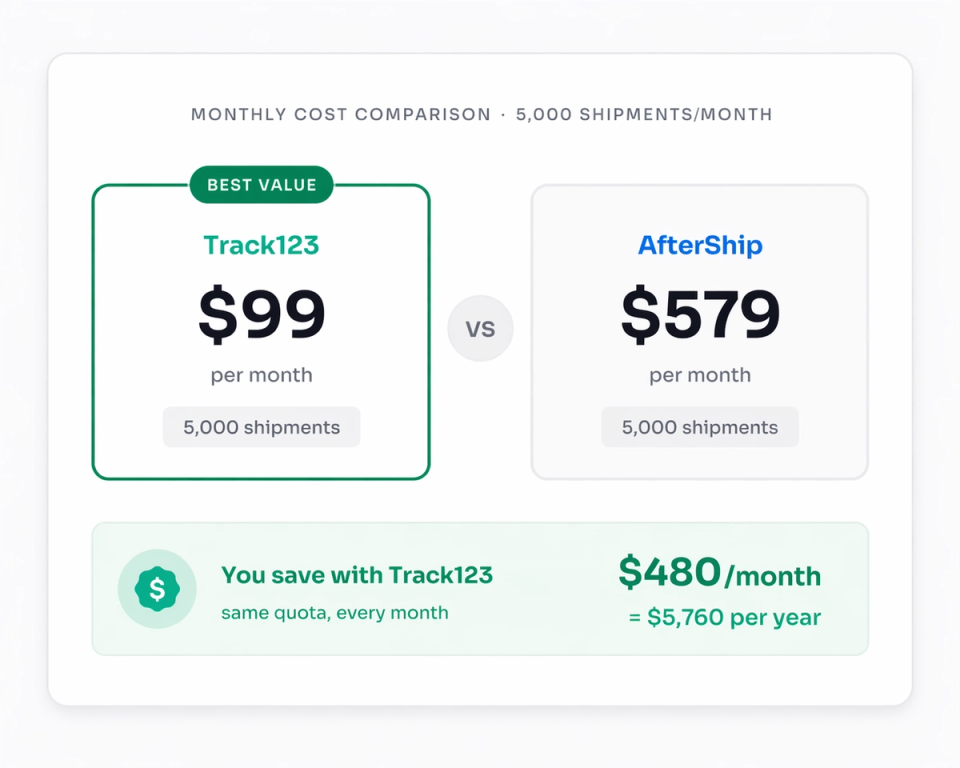
That's not a rounding error — Track123 costs 83% less than AfterShip for the exact same shipment quota. And the gap doesn't close at higher volumes. In fact, it widens.
The overage trap
Most tracking tools charge extra when you exceed your monthly quota — a common scenario during peak seasons like Black Friday or the holiday rush. Here's where things get even more lopsided:
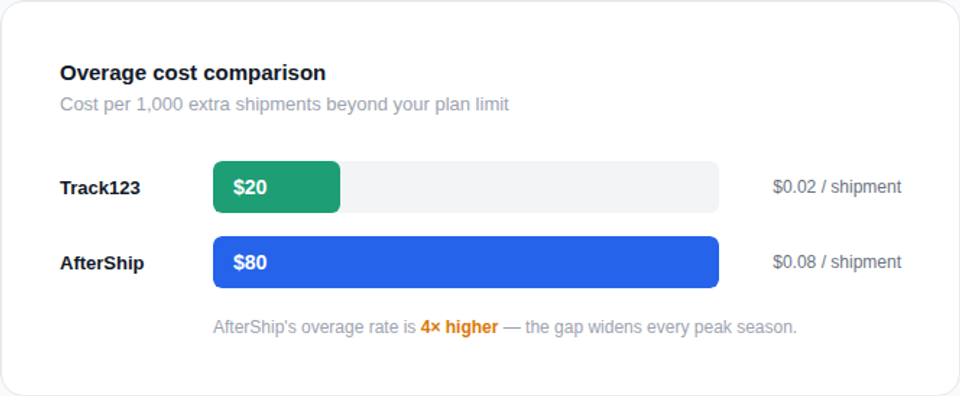
During a heavy sales month where you process 2,000 extra shipments above your plan, AfterShip charges $160 in overages. Track123 charges $40. That's $120 in one month alone — just from overflow traffic.
$5,760/year in base-plan savings. Multiply that with overage cost differences during peak seasons, and the real annual gap for a growing seller can easily exceed $7,000–$8,000.
To put it in perspective: $5,760/year is roughly equivalent to a month of mid-tier Facebook ad spend, a part-time customer service hire, or a full year of your Shopify plan. It's real money that could go back into growth.
Full feature comparison
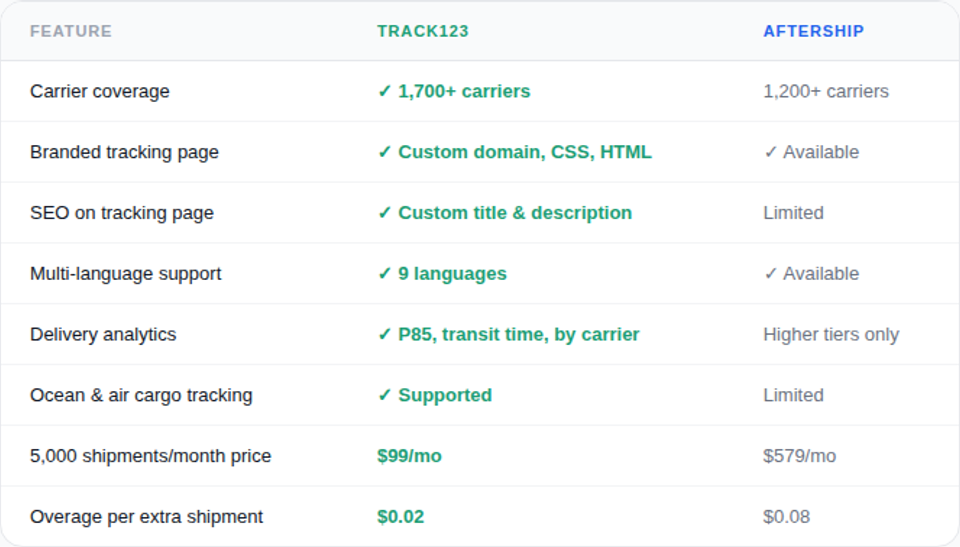
Price only matters if the product delivers. Here's how Track123 and AfterShip compare across every major dimension:
Carrier coverage: more carriers, less worry
Track123 aggregates data from 1,700+ carriers globally, compared to AfterShip's 1,200+. For most standard US/EU routes, both tools cover what you need. But if your business touches emerging markets — Southeast Asia, the Middle East, Latin America, or Eastern Europe — carrier breadth starts to matter a lot.
Track123 also supports tracking for ocean cargo and air freight (Bill of Lading / AWB), making it a strong choice for businesses that go beyond standard parcel shipping. AfterShip's support for cargo shipment types is more limited.
Tracking page: your brand, your rules
A tracking page isn't just a utility — it's a post-purchase touchpoint that shapes how customers feel about your brand. Track123 gives you full control over this experience.
You can set a custom domain (e.g. track.yourstore.com), add custom CSS and HTML for full visual alignment with your brand, configure multilingual display across 9 languages including English, French, German, Japanese, and Korean, and set custom SEO titles and descriptions so your tracking page can be found organically.
AfterShip also offers a branded tracking page, but advanced customization options are primarily available on higher-tier plans. For teams that want deep brand control without enterprise pricing, Track123 is the more accessible option.
Analytics: understand what's actually happening
Track123's analytics module is built for sellers who want to turn shipping data into operational decisions — not just see a dashboard. Key metrics include:
Average transit time gives you a baseline measure of how fast shipments are reaching customers. P85 transit time — the 85th percentile — tells you whether your slowest deliveries are outliers or a pattern. Transit time by carrier and destination lets you compare performance across different carriers to the same region, which is invaluable when deciding which carrier to use for specific markets.
AfterShip also has analytics capabilities, though the depth of delivery-specific performance analysis tends to be concentrated in its higher-tier plans.
API and Webhook: developer-friendly from day one
Both platforms offer a full REST API and Webhook support. Track123's API is straightforward to get started with — the Quick Start guide walks you through obtaining your API key and making your first requests in minutes. Key specs worth knowing:
The Register Tracking API supports up to 100 tracking numbers per request at 3 requests/second. The Get Tracking API supports 100 tracking numbers per request at 5 requests/second. Webhook setup is a simple URL configuration — no complex event routing required.
For teams that want to integrate tracking into their existing stack without heavy engineering investment, Track123's API surface is clean, well-documented, and sufficient for most use cases.
Who should use which tool?
The honest verdict
Both are solid products. The right choice depends on what your business actually needs.
Choose Track123 if...
- You ship 500–10,000+ orders/month and care about cost
- You need broad carrier coverage for cross-border shipments
- You want a fully branded tracking page without enterprise pricing
- You need ocean or air cargo tracking
- You want clean analytics to optimize carrier selection
- You're a growing brand that wants to reinvest savings into growth
Choose AfterShip if...
- You're deeply integrated into their Returns or AI EDD products
- You need AfterShip's full post-purchase suite under one roof
- Enterprise SLA and dedicated account management are non-negotiable
- Your budget is not a primary constraint
The bottom line
AfterShip is a well-built product with a strong brand. But for the vast majority of eCommerce sellers — especially those scaling from hundreds to thousands of monthly shipments — paying 5× more for the same quota doesn't add up.
Track123 covers 1,700+ carriers, offers a fully customizable branded tracking page, delivers actionable delivery analytics, and provides a clean API and Webhook setup. All at $99/month for 5,000 shipments, versus AfterShip's $579.
If you're currently paying for AfterShip and haven't revisited that decision recently, the math is worth a second look.